













Coordinates describe individual squares.
Board regions group squares into larger spatial areas.
Chess language frequently refers to:
- the center;
- the extended center;
- kingside;
- queenside;
- wings or flanks;
- home ranks;
- advanced ranks;
- neighbouring squares.
These terms are useful because players rarely think only in isolated coordinates.
But regional language must remain precise enough that:
- orientation is clear;
- relative terms state whose perspective they use;
- common terminology is not falsely presented as universally standardized.
Board-region language is most useful first as a descriptive map.
Strategic claims about:
- controlling the center;
- attacking a wing;
- gaining space;
- occupying advanced squares
belong to later domains.
Core center
The standard four-square core center is:
- d4;
- e4;
- d5;
- e5.
These four squares form the central 2×2 block of the orthodox 8×8 board.
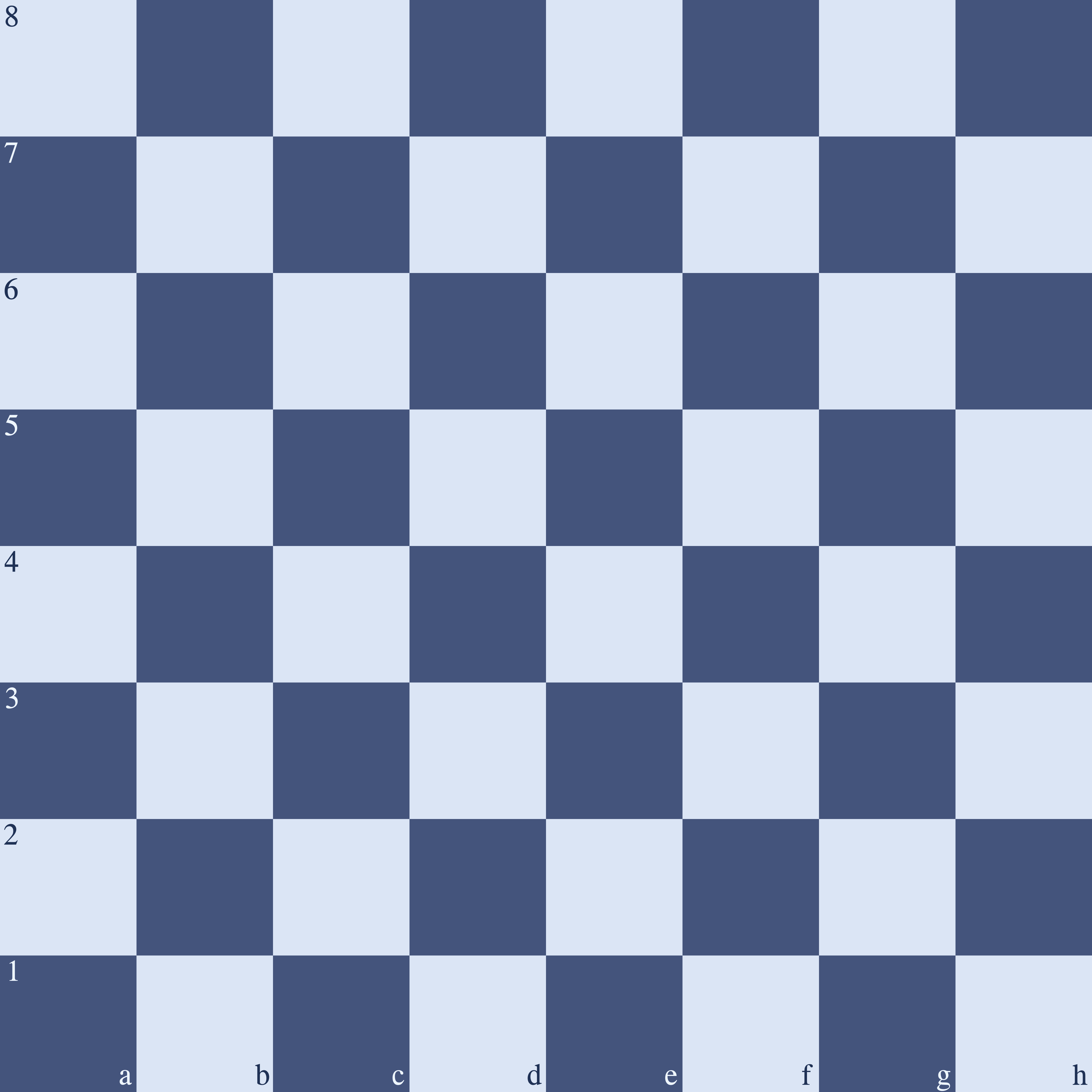
Core center
Exactly:
- d4;
- e4;
- d5;
- e5.
Center
When precision matters, use:
core centerfor the four-square definition;broader/extended centerfor the sixteen-square definition introduced below.
In general prose, center can still refer to the central area if context makes the intended scope clear.
Core center = d4, e4, d5, e5.
Why this is a spatial definition here
The core center is geometrically central because it is the 2×2 block around the exact midpoint of an even-sized 8×8 board.
These geometric labels alone do not tell you:
- occupying it is always good;
- controlling it guarantees an advantage;
- central pieces are always superior.
Those are chess-evaluation claims.
Broader / extended center
Chess authors do not always use center and extended center with exactly the same boundaries.
A common broader definition adds the twelve squares surrounding the four-square core.
Because "extended center" is used inconsistently, this guide uses one explicit definition.
A practical extended-center definition
The sixteen-square block:
- files c–f;
- ranks 3–6.
That is:
c6 d6 e6 f6
c5 d5 e5 f5
c4 d4 e4 f4
c3 d3 e3 f3
The four core-center squares are contained inside it:
- d4;
- e4;
- d5;
- e5.
The other twelve form the surrounding ring.
Why a house definition is necessary
Chess terminology varies.
Some sources:
- reserve
centerfor the four core squares; - use
extended centerfor the surrounding twelve plus the core; - use
centermore broadly in ordinary prose; - sometimes refer to central files such as d/e as "the center" in a different context.
Do not assume:
"Every chess author always means these exact sixteen squares when saying extended center."
Instead:
In this guide, the extended center means the 4×4 block c3–f6.
Regional terminology is useful only when its boundaries are stated.
Core vs extended-center exercise
Classify each square as:
- core center;
- extended-center ring;
- outside the extended center used here.
Squares:
- d4
- e5
- c3
- f6
- c5
- g4
- d7
- b2
Answers:
- core;
- core;
- extended ring;
- extended ring;
- extended ring;
- outside;
- outside;
- outside.
Kingside and queenside
The board can also be divided according to the files associated with the king and queen in the standard starting position.
Queenside
Files:
- a;
- b;
- c;
- d.
The queen begins on:
- d1 for White;
- d8 for Black.
So the half containing the starting queen file is called the queenside.
Kingside
Files:
- e;
- f;
- g;
- h.
The king begins on:
- e1 for White;
- e8 for Black.
So the half containing the starting king file is called the kingside.
Queenside = a–d files. Kingside = e–h files.
Kingside/queenside do not swap when the board flips
A flipped digital board changes:
- visual left/right.
It does not change:
- queenside;
- kingside.
From White-bottom view:
- queenside appears visually left;
- kingside appears visually right.
From Black-bottom view:
- kingside appears visually left;
- queenside appears visually right.
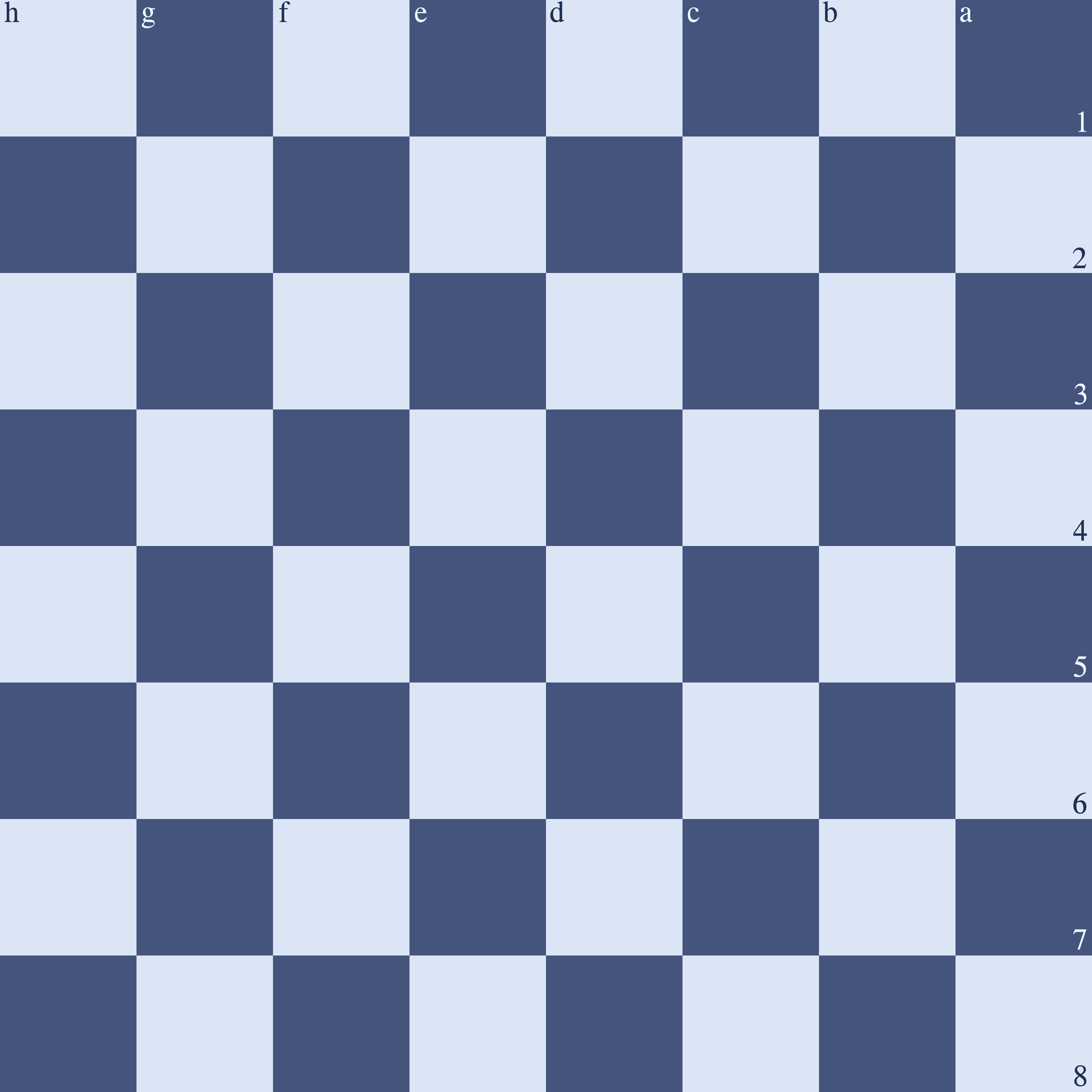
Kingside/queenside are coordinate-defined regions, not permanent screen-left/screen-right labels.
Why "left wing" can be ambiguous
If someone says:
"the left side of the board"
the meaning changes with viewpoint.
If they say:
"the queenside"
the coordinate region is clear.
For clarity, prefer:
- kingside;
- queenside;
- file names
when orientation ambiguity matters.
Wings and flanks
Chess language commonly uses:
wing;flank.
These often refer to the outer parts of the kingside or queenside away from the central files.
But authors do not always partition the exact files identically.
This guide uses:
Kingside wing / kingside flank
A descriptive region toward:
- f-, g-, and h-files,
with exact scope stated when necessary.
Queenside wing / queenside flank
A descriptive region toward:
- a-, b-, and c-files,
with exact scope stated when necessary.
Center
Core/broader central region as defined in context.
Central files
Primarily:
- d-file;
- e-file
when a two-file central reference is intended.
Do not create a false universal rule such as:
"The kingside flank is officially exactly f–h in all chess literature."
It is conventional spatial language, not a FIDE board partition.
Why d/e are useful central-file anchors
The d- and e-files pass directly through all four core-center squares:
- d4;
- d5;
- e4;
- e5.
So when this guide says:
central files
without a broader definition, the default geometric meaning is:
- d-file;
- e-file.
Board-region map
Home ranks
Rank language can be absolute:
- first rank;
- second rank;
- seventh rank;
- eighth rank.
But home language is relative to color.
White home side
White begins on:
- rank 1;
- rank 2.
Useful descriptive phrases include:
- White back rank = rank 1;
- White pawn-starting rank = rank 2.
Black home side
Black begins on:
- rank 8;
- rank 7.
So:
- Black back rank = rank 8;
- Black pawn-starting rank = rank 7.
Absolute rank number stays fixed. "Home" depends on color.
Back rank
In standard chess language:
White back rank
- rank 1.
Black back rank
- rank 8.
This is where:
- kings;
- queens;
- rooks;
- bishops;
- knights
begin in the standard initial position.
Use:
White's back rank;Black's back rank
when relative meaning matters.
Do not call rank 1:
"the back rank"
without context if both colors are being discussed.
Advanced ranks
Advanced is relative to the side/chessman.
A White chessman moving toward Black's side tends toward:
- higher rank numbers.
A Black chessman moving toward White's side tends toward:
- lower rank numbers.
Therefore the same absolute rank can be:
- advanced for one color;
- near home for the other.
White examples
White piece on:
- rank 6 or 7
may be described spatially as far advanced toward Black's side.
Black examples
Black piece on:
- rank 3 or 2
may be far advanced toward White's side.
Advanced does not mean:
- good;
- safe;
- strategically desirable.
It is a relative spatial description.
Strategic advanced pieces/pawns belong later.
Relative-rank mapping
A useful teaching device is to map ranks from each player's own perspective.
| Absolute rank | White-relative distance from home back rank | Black-relative distance from home back rank |
|---|---|---|
| 1 | 0 | 7 |
| 2 | 1 | 6 |
| 3 | 2 | 5 |
| 4 | 3 | 4 |
| 5 | 4 | 3 |
| 6 | 5 | 2 |
| 7 | 6 | 1 |
| 8 | 7 | 0 |
Half-board language
For simple spatial orientation, the board may also be described as:
White half
Ranks:
- 1–4.
Black half
Ranks:
- 5–8.
This division is absolute relative to the standard starting sides.
It can help describe:
- crossing the midpoint;
- route location;
- where a piece currently stands.
When using White half / Black half, define them explicitly as:
- White half = ranks 1–4;
- Black half = ranks 5–8.
Do not equate this descriptive half with:
- legal ownership;
- strategic territory;
- space advantage.
Adjacency
Two squares are adjacent when they share a border or corner in the king-neighbourhood sense:
- orthogonally adjacent;
- diagonally adjacent.
From an interior square:
- up to 8 adjacent neighbours.
Orthogonal neighbours
Squares that differ by one step in exactly one coordinate.
From d4:
- c4;
- e4;
- d3;
- d5.
These share:
- a rank;
or
- a file.
Diagonal neighbours
Squares that differ by one file and one rank.
From d4:
- c3;
- c5;
- e3;
- e5.
Full king neighbourhood
Union of:
- orthogonal neighbours;
- diagonal neighbours.
From d4: 8 squares.
This is why king adjacency is a natural general neighbourhood model.
King neighbourhood = all board-adjacent squares.
Edge effects
From:
- corner → 3 neighbours;
- non-corner edge → 5;
- interior → 8.
This was introduced in 03.3 for king geometry.
Here it becomes a generic board-neighbourhood concept.
Piece-specific relevance of adjacency
Adjacency matters differently for different chessmen.
King
All adjacent squares match raw movement/attack geometry.
Pawn
Only diagonal-forward adjacent squares are attack directions.
The forward orthogonal square can be a movement destination but is not attacked.
Knight
Adjacent squares are not knight destinations.
Slider
Adjacent same-line squares are the first possible squares on rays, but the piece may reach much farther.
"Adjacent" is a board relation. What it means for movement depends on the piece.
Neighbourhood exercise
1. d4
List:
- orthogonal neighbours;
- diagonal neighbours;
- full neighbourhood.
2. a1
List all adjacent squares.
Answer:
- a2;
- b1;
- b2.
3. a5
Count:
- 5 neighbours.
4. Pawn interpretation
White pawn d4.
From the full 8-square neighbourhood, identify:
- forward movement square;
- attack squares;
- irrelevant backward/sideways squares.
5. Knight interpretation
Knight d4.
Question: How many of its 8 adjacent neighbours are knight destinations?
Answer: 0.
Regional language discipline
"Center always means exactly the same thing in every source."
Wrong.
Here, we explicitly define:
- core center;
- extended center.
Other authors may use broader language.
"Kingside is always the right side of my screen."
Wrong.
It is:
- files e–h.
Screen orientation can flip.
"Advanced rank means high rank number."
Only for White-oriented progress.
Black advances toward lower rank numbers.
"White half means White controls those squares."
Wrong.
It is only a geometric half-board label here.
"Adjacent means the piece can move there."
Wrong.
Adjacency is a square relation.
Movement is piece-specific.
Putting chessboard regions together
Core center
- d4;
- e4;
- d5;
- e5.
A practical extended-center definition
- 4×4 block c3–f6;
- includes core + surrounding twelve squares.
Queenside
- files a–d.
Kingside
- files e–h.
Wings/flanks
- conventional outer-side spatial language;
- exact scope can vary by author.
Central files
Default narrow reference:
- d-file;
- e-file.
Home/advanced language
- relative to color;
- rank coordinates remain absolute.
White/Black halves
- White half = ranks 1–4;
- Black half = ranks 5–8;
- descriptive only.
Adjacency
- orthogonal + diagonal neighbours;
- movement relevance is piece-specific.
Board-region mastery check
- [ ] I know the four core-center squares.
- [ ] I know the 16-square extended-center definition used in this guide.
- [ ] I understand center terminology can vary across sources.
- [ ] I identify queenside as a–d and kingside as e–h.
- [ ] I do not equate kingside with permanent visual right.
- [ ] I use flank/wing language cautiously.
- [ ] I distinguish absolute ranks from color-relative home/advanced language.
- [ ] I can identify White/Black halves descriptively.
- [ ] I list orthogonal and diagonal neighbours.
- [ ] I distinguish board adjacency from piece movement.
The next section asks how to measure and traverse the board:
How far apart are two squares for a particular chessman, and what route connects them?