













Coordinates tell us where a square is.
Lines tell us how squares relate across the board.
The chessboard contains three fundamental straight-line families:
- files;
- ranks;
- diagonals.
Rooks, bishops, and queens use these structures directly.
But line geometry matters even when no sliding chessman occupies the board. It gives us a way to see:
- alignment;
- direction;
- distance along a line;
- intersections;
- blockers;
- lines of sight;
- future attack structures.
The purpose of this area is to make those relationships visually immediate.
Straight lines on the chessboard
In ordinary chess language, a square can be related to another square through:
- the same file;
- the same rank;
- the same diagonal.
These are the board's principal straight-line structures.
Files
A file is a vertical column of eight squares.
Example:
The e-file contains:
- e1;
- e2;
- e3;
- e4;
- e5;
- e6;
- e7;
- e8.
Ranks
A rank is a horizontal row of eight squares.
Example:
The fourth rank contains:
- a4;
- b4;
- c4;
- d4;
- e4;
- f4;
- g4;
- h4.
Diagonals
FIDE defines a diagonal as a straight line of same-coloured squares running from one edge of the board to an adjacent edge.
Examples:
- a1-b2-c3-d4-e5-f6-g7-h8;
- c1-d2-e3-f4-g5-h6;
- a6-b7-c8.
Line alignment between two squares
Two squares are aligned in straight-line geometry when they share:
- a file;
- a rank;
- or a diagonal.
Examples:
Same file
- e2 and e7.
Same rank
- b4 and g4.
Same diagonal
- c2 and f5.
Not aligned:
- c3 and f5.
Those two squares share:
- neither file;
- nor rank;
- nor diagonal.
Aligned or not?
Classify:
- a1 / a8
- c4 / h4
- b2 / e5
- a7 / d4
- c3 / f5
- h1 / e4
Answers:
- file;
- rank;
- diagonal;
- diagonal;
- not aligned;
- diagonal.
A line vs a segment
For practical board vision, it is useful to distinguish:
Full board line
The complete rank/file/diagonal running from one board boundary to another.
Example:
- the entire e-file.
Segment between two squares
Only the portion of that line between two selected squares.
Example:
- segment e2-e7.
That segment includes:
- e2;
- e3;
- e4;
- e5;
- e6;
- e7.
If we care only about the squares between e2 and e7, we mean:
- e3;
- e4;
- e5;
- e6.
Full line = whole board structure. Segment = selected portion between endpoints.
This distinction becomes useful when checking:
- blockers;
- distance;
- line of sight;
- interposition.
Direction along a line
A line itself has no preferred direction.
But from a chosen starting square, the line can be read in opposite directions.
From d4:
File directions
- toward d5-d6-d7-d8;
- toward d3-d2-d1.
Rank directions
- toward e4-f4-g4-h4;
- toward c4-b4-a4.
Diagonal directions
- toward e5-f6-g7-h8;
- toward c5-b6-a7;
- toward e3-f2-g1;
- toward c3-b2-a1.
That creates:
- 2 file directions;
- 2 rank directions;
- 4 diagonal directions.
A queen on an empty board therefore has up to 8 directional rays from one square.
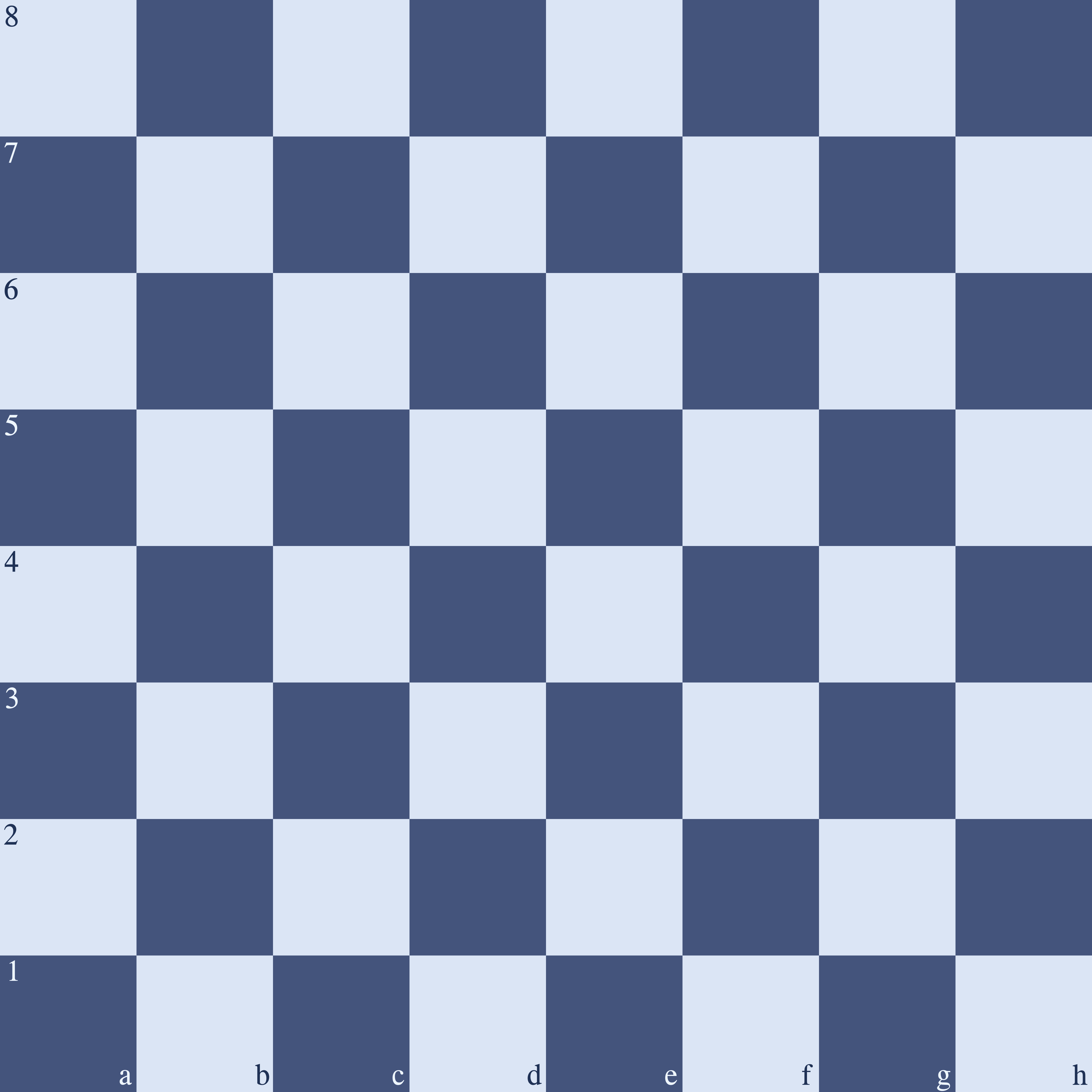
Diagonals
Diagonals deserve separate treatment because their geometry differs from ranks and files.
A rank/file is always length 8.
A diagonal can be:
- short;
- medium;
- long.
Its length depends on where it lies.
Diagonal lengths vary
Examples:
Length 8
- a1-h8;
- h1-a8.
Length 7
- a2-g8;
- b1-h7;
- h2-b8;
- g1-a7.
Shorter diagonals
- a7-b8 → length 2;
- a8 alone can be treated as a one-square diagonal endpoint structure in geometric enumeration.
Same-color property
Every square on one diagonal has the same color.
Example:
a1-b2-c3-d4-e5-f6-g7-h8
All are dark squares.
The other long diagonal:
h1-g2-f3-e4-d5-c6-b7-a8
consists entirely of light squares.
Diagonal movement preserves square color.
This is why:
- a bishop remains permanently color-bound.
How to test whether two squares share a diagonal
A practical visual test:
Move from the first square toward the second.
If every step changes:
- file by one;
- rank by one;
in consistent directions, the squares share a diagonal.
Examples:
c2 → d3 → e4 → f5
Yes.
c2 → d4
No.
The file changes by 1 but rank changes by 2.
Coordinate-difference test
For advanced readers, map file letters to numbers:
- a=1;
- b=2;
- ...
- h=8.
Two squares share a diagonal when:
absolute file difference = absolute rank difference
Example:
c2 → f5
- file difference: 3;
- rank difference: 3.
Same diagonal.
Example:
c2 → f4
- file difference: 3;
- rank difference: 2.
Not same diagonal.
This test is useful in:
- programmatic diagram QA;
- coordinate drills;
- engine/game tooling;
but practical players should ultimately recognize diagonals visually.
Diagonal direction families
A bishop standing on a square can usually project into up to four diagonal directions.
Using White-bottom coordinate language:
- file increasing + rank increasing;
- file decreasing + rank increasing;
- file increasing + rank decreasing;
- file decreasing + rank decreasing.
Example from d4:
- e5-f6-g7-h8;
- c5-b6-a7;
- e3-f2-g1;
- c3-b2-a1.
Edge truncation
A diagonal stops when:
- the board edge is reached.
That means the same directional idea can produce:
- many squares from the center;
- few from an edge/corner.
Example:
Bishop geometry from d4: multiple long branches.
From a1: only one diagonal direction remains:
- b2-c3-d4-e5-f6-g7-h8.
The direction family remains the same; the board boundary truncates the path.
Same diagonal exercises
For each pair, answer:
- same diagonal?
- if yes, list intermediate squares.
1. a1 / h8
Yes.
Intermediate: b2-c3-d4-e5-f6-g7.
2. c1 / h6
Yes.
Intermediate: d2-e3-f4-g5.
3. c1 / h5
No.
4. h1 / a8
Yes.
Intermediate: g2-f3-e4-d5-c6-b7.
5. b6 / e3
Yes.
Intermediate: c5-d4.
6. b6 / f3
No.
The two long diagonals
The chessboard contains two eight-square corner-to-corner diagonals.
a1-h8
Squares:
- a1;
- b2;
- c3;
- d4;
- e5;
- f6;
- g7;
- h8.
This is a dark-square diagonal.
h1-a8
Squares:
- h1;
- g2;
- f3;
- e4;
- d5;
- c6;
- b7;
- a8.
This is a light-square diagonal.
Why these diagonals matter visually
They are useful orientation anchors because:
- each spans the full board corner-to-corner;
- they pass through central squares;
- they make same-color diagonal structure obvious;
- many common board relationships can be located relative to them.
At this stage, do not infer strategic value simply because a diagonal is long.
Strategic use of:
- long diagonals;
- bishop pressure;
- fianchetto structures
belongs later.
Long diagonal is a geometric description, not automatically a strategic advantage.
Rays
In this guide, a ray is a directional portion of a line extending outward from a chosen square until:
- the board edge;
- or, when discussing direct piece reach, the first blocker.
This is a useful explanatory term.
It is not required FIDE terminology.
Line
A full rank/file/diagonal structure.
Ray
One direction outward from a chosen origin square along an allowed line family.
Segment
A finite portion between selected squares.
Use ray when describing:
- direction-specific slider geometry;
- blockers;
- line-of-sight;
- attack scans.
Rook rays
A rook on an empty board has four directional rays:
- up file;
- down file;
- left along rank;
- right along rank.
Example: rook d4.
Rays:
- d5-d6-d7-d8;
- d3-d2-d1;
- e4-f4-g4-h4;
- c4-b4-a4.
Bishop rays
A bishop on an empty board has up to four diagonal rays.
Example: bishop d4:
- e5-f6-g7-h8;
- c5-b6-a7;
- e3-f2-g1;
- c3-b2-a1.
Because bishops are color-bound:
- every ray remains on the bishop's current square color.
Queen rays
A queen combines:
- 4 rook-style rays;
- 4 bishop-style rays.
From an unrestricted interior square:
up to 8 directional rays.
Rays and blockers
At pure board-structure level, a line may continue geometrically beyond an occupied square.
But direct sliding access from the origin stops at the first blocker.
This distinction is important.
Suppose:
- White rook d4;
- White pawn d6.
The d-file itself still exists:
d1-d2-d3-d4-d5-d6-d7-d8.
But from the rook's origin:
- ray upward has direct access to d5;
- blocker at d6 stops the rook;
- d7/d8 remain part of the same geometric file;
- but are not directly reachable from the rook through the blocker.
The line continues beyond a blocker. Direct reach does not.
This concept prevents sloppy wording such as:
"The file ends at the pawn."
No.
The file continues.
The rook's unobstructed ray ends.
Friendly and enemy first blockers
From a geometry scan:
Friendly first blocker
- cannot be entered;
- terminates direct sliding reach.
Enemy first blocker
- can be the first capture/contact square;
- terminates direct reach beyond it.
The board line beyond the blocker remains geometrically present.
Ray scanning as a board-vision skill
For sliders, a useful static scan is:
- choose origin;
- choose one direction;
- move square by square;
- stop at board edge or first blocker;
- repeat next direction.
This is easier and less error-prone than trying to perceive the entire footprint as one vague shape.
Trace every ray
Position:
- queen e4;
- several friendly/enemy blockers.
Task: For each of the eight directions:
- list squares before first blocker;
- identify blocker square;
- identify squares geometrically beyond blocker.
Do not ask whether a tactical capture is good.
Learning goal: Build line/ray parsing.
Ray vs route
A ray is straight and directional.
A route can involve several moves and may change direction over time.
Example:
Bishop:
- one move travels on one diagonal ray/segment.
Knight route:
- may require several jumps.
King route:
- may zigzag.
Route geometry builds on these line relationships later in the sequence.
Files, ranks, diagonals, and rays summary
The board contains three straight-line families:
- files;
- ranks;
- diagonals.
Alignment
Two squares can share:
- file;
- rank;
- diagonal.
Diagonal
- same-colored squares;
- variable length;
- two maximum eight-square diagonals:
- a1-h8;
- h1-a8.
Line
Full board structure.
Segment
Selected finite part of a line.
Ray
One direction from an origin square.
Blocker
Stops direct sliding reach without erasing the geometric line beyond it.
Line-geometry mastery check
- [ ] I recognize file/rank/diagonal alignment.
- [ ] I distinguish a full line from a segment.
- [ ] I can test whether two squares share a diagonal.
- [ ] I know the two eight-square long diagonals.
- [ ] I can trace rook rays.
- [ ] I can trace bishop rays.
- [ ] I can trace queen rays.
- [ ] I understand a blocker stops direct reach, not the existence of the board line.
The next section uses these lines together:
- where they intersect;
- which chessmen align;
- when line of sight is clear;
- how lines open and close;
- how board geometry transforms under symmetry.