













Before learning how any chessman moves, a player should be able to set up the board confidently and recognize the initial position at a glance.
This guide introduces only the board language needed for setup. Coordinate fluency, diagonals, regions, lines, and attack maps are developed separately once the starting position feels automatic.
The 8×8 chessboard
An orthodox chessboard is an 8 × 8 grid containing 64 squares.
The squares alternate between two colors, conventionally called light and dark squares. Physical boards may use white and black, cream and brown, wood tones, or many other color combinations. Digital boards may use completely different visual themes.
The actual colors are not what defines the game. What matters is the alternating pattern and the correct orientation of the board.
| Board dimension | Count |
|---|---|
| Files | 8 |
| Ranks | 8 |
| Total squares | 64 |
Only one chessman can occupy a square at a time.
A square may therefore be:
- empty;
- occupied by a White chessman;
- occupied by a Black chessman.
How occupancy affects movement and capture is introduced in the movement and capture sections.
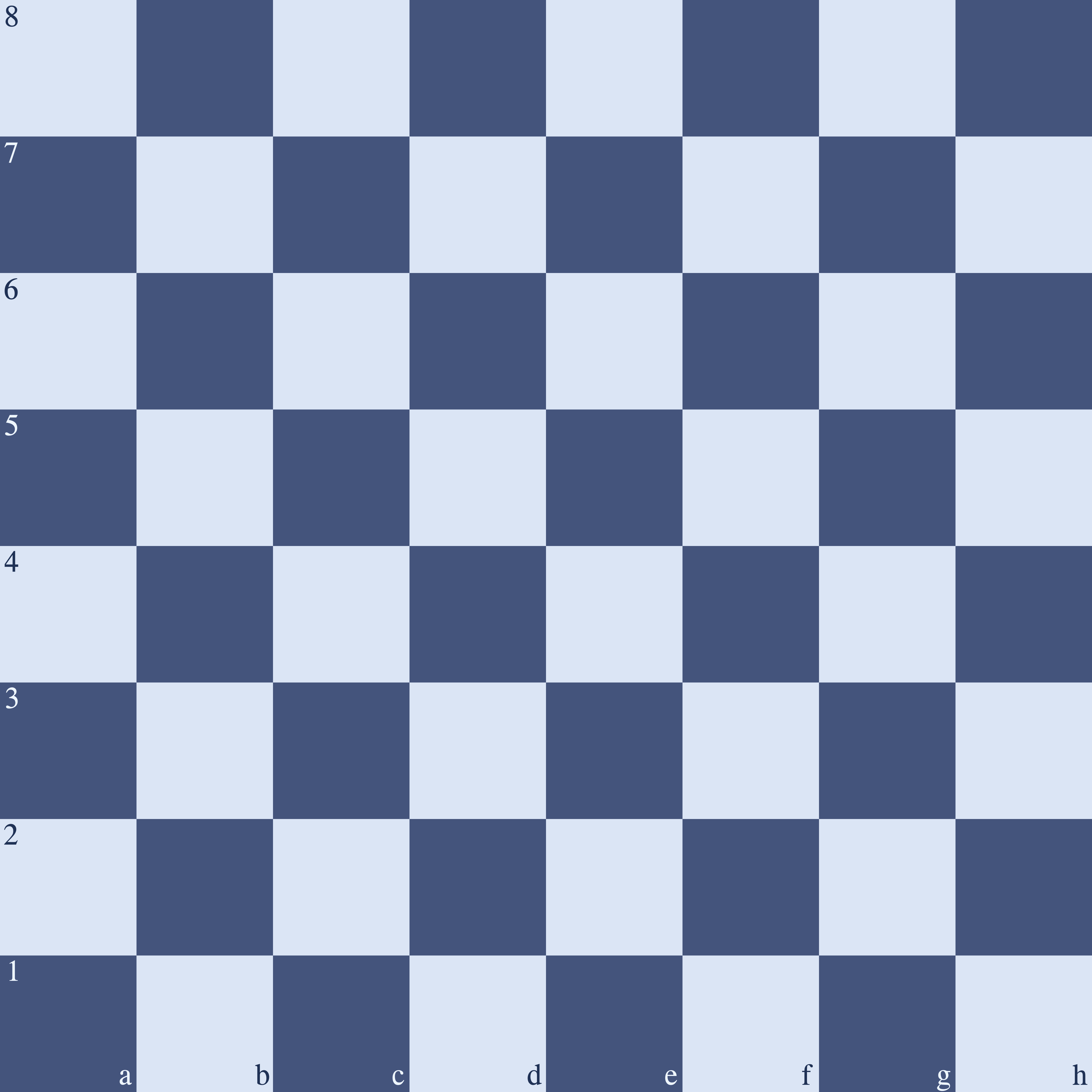
Correct board orientation
The board must be turned the right way before the armies are placed.
The simplest orientation rule is:
the near-right corner square must be light.
For White, the square in the bottom-right corner is light. The same is true from Black's own perspective: each player has a light square at the near-right corner.
A common beginner error is to rotate the board by ninety degrees. The pieces can still be physically placed on it, but the setup will no longer correspond to the standard chessboard.
Light on the right.
This is an orientation rule, not a rule for placing the queen. It tells you how the board itself must face before any chessman is arranged.

Do not begin by memorizing where the queen goes while the board itself is rotated incorrectly. First orient the board. Then build the position.
White's side, Black's side, and perspective
The two players sit on opposite sides of the same board.
From the standard White-at-the-bottom diagram orientation:
- White begins on the first and second ranks;
- Black begins on the eighth and seventh ranks.
The rows closest to each player's back rank are often informally described as that player's home side of the board.
VeyraPlay diagrams normally show White at the bottom unless another orientation is explicitly useful.
That is only a presentation convention. The position itself does not change if a physical board is viewed from Black's side.
The chess army
Each side begins with sixteen chessmen.
The starting army contains:
- 1 king;
- 1 queen;
- 2 rooks;
- 2 bishops;
- 2 knights;
- 8 pawns.
White and Black begin with the same types and quantities of chessmen.
| Chessman | Per side | Both sides combined |
|---|---|---|
| King | 1 | 2 |
| Queen | 1 | 2 |
| Rook | 2 | 4 |
| Bishop | 2 | 4 |
| Knight | 2 | 4 |
| Pawn | 8 | 16 |
| Total | 16 | 32 |
At this point, the names and identities matter more than their strategic value. A rook is not "five points" because of what it is called, and a queen is not simply "the strongest piece" in every useful sense. Approximate material values are introduced later in the foundations sequence, after movement and capture are understood.
The initial position
Once the board is correctly oriented, the starting position can be built systematically.
Pawns
White's eight pawns occupy the entire second rank.
Black's eight pawns occupy the entire seventh rank.
They form the front line of each starting army.
Rooks
The rooks begin in the four corners:
- White rooks on the two corners of White's back rank;
- Black rooks on the corresponding corners of Black's back rank.
Knights
Each knight begins immediately inside a rook.
The back rank now has:
rook — knight — ... — knight — rook
Bishops
Each bishop begins immediately inside a knight.
The structure becomes:
rook — knight — bishop — ... — bishop — knight — rook
Queen and king
The two central squares of each back rank are occupied by the queen and king.
A useful setup mnemonic is:
the queen begins on her own color.
That means:
- White's queen begins on a light square;
- Black's queen begins on a dark square.
The king occupies the remaining central square beside the queen.
This mnemonic is useful for checking the setup, but the actual position should eventually become familiar enough that it does not need to be reconstructed from a phrase every time.
Queen on her own color
White queen: light square. Black queen: dark square.
Use this as a setup check, not as a substitute for learning the actual initial position.
Why the two armies mirror each other
The initial position is symmetrical in material and piece type.
White and Black begin with:
- the same number of chessmen;
- the same piece types;
- corresponding piece placement on opposite sides.
But there is one immediate asymmetry in the game:
White moves first.
That difference is enough to mean that the two sides do not have identical practical roles on every move, even though their starting armies are mirrored.
Opening guides later examine what the first move means strategically. Here the important point is simply that equal starting material does not mean simultaneous action.
Checking the setup
Before beginning a game, use a quick setup scan.
1. Is the board oriented correctly?
Near-right corner: light square.
If not, rotate the board before doing anything else.
2. Are all sixteen chessmen present for each side?
Each side should have:
- 8 pawns;
- 2 rooks;
- 2 knights;
- 2 bishops;
- 1 queen;
- 1 king.
3. Are the pawns on the correct ranks?
White: second rank. Black: seventh rank.
4. Are the rooks in the corners?
If a rook is not in a starting corner, the rest of the back rank is probably shifted.
5. Do the pieces progress inward correctly?
From each corner toward the center:
rook → knight → bishop
6. Are the queen and king in the correct central squares?
Use the mnemonic:
queen on her own color.
If the queens do not face each other across the board in the standard starting position, check the setup again.
Find the setup errors
Create a diagram with several intentional errors, for example:
- board rotated ninety degrees;
- White king and queen swapped;
- one bishop and knight swapped;
- one pawn missing.
Question: Identify every error before correcting the position.
Learning goal: Make setup checking active rather than purely memorized.
Rebuild the starting position
Start from an empty correctly oriented board.
Task:
- Place all pawns.
- Place rooks.
- Place knights.
- Place bishops.
- Place queens.
- Place kings.
- Verify both armies.
Solution:
- White army on ranks 1–2;
- Black army on ranks 8–7;
- back-rank order from White's left to right:
rook, knight, bishop, queen, king, bishop, knight, rook;
- Black mirrors the same arrangement from White's standard diagram perspective.
Learning goal: Reconstruct the position without copying a reference board.
Can you set up the board from memory?
Before moving on to piece movement, try to answer all of these without guessing:
- How many squares are on the board?
- Which color should the near-right corner be?
- How many chessmen does each side begin with?
- How many of each type?
- Where do the pawns begin?
- What is the back-rank order?
- How can the queen's starting square be checked?
- Which side moves first?
If any of those still feels uncertain, rebuild the board once or twice from an empty position. Setup fluency removes unnecessary confusion when movement is introduced next.
Chess board setup FAQ
Which color goes on the right when setting up a chess board?
The near-right corner should be a light square. The traditional mnemonic is light on right.
Where do the king and queen start?
From White's perspective, the queen starts on d1 and the king on e1. Black's queen starts on d8 and king on e8. The mnemonic queen on her own color helps catch a swapped king and queen.
How many pieces does each player start with?
Each side begins with sixteen chessmen: eight pawns, two rooks, two knights, two bishops, one queen, and one king.
Does the board setup change depending on which side I sit on?
No. The standard starting position is fixed. What changes is your visual perspective: Black sees the same board from the opposite side.