






Lines do not exist independently.
They cross.
Chessmen occupy them.
Blockers open and close access along them.
Several chessmen can become aligned on one rank, file, or diagonal.
And the whole board can be transformed through reflections and rotations while preserving some geometric relationships.
This section turns isolated line knowledge into a connected board structure.
Intersections
Every file intersects every rank exactly once.
Example:
- e-file;
- fourth rank;
intersect on:
e4.
That is simply the coordinate system from 03.1 viewed geometrically.
But diagonals create additional intersection relationships.
File-rank intersections
There are:
- 8 files;
- 8 ranks.
Each file crosses each rank once.
That gives:
- 64 file-rank intersections;
- exactly the 64 board squares.
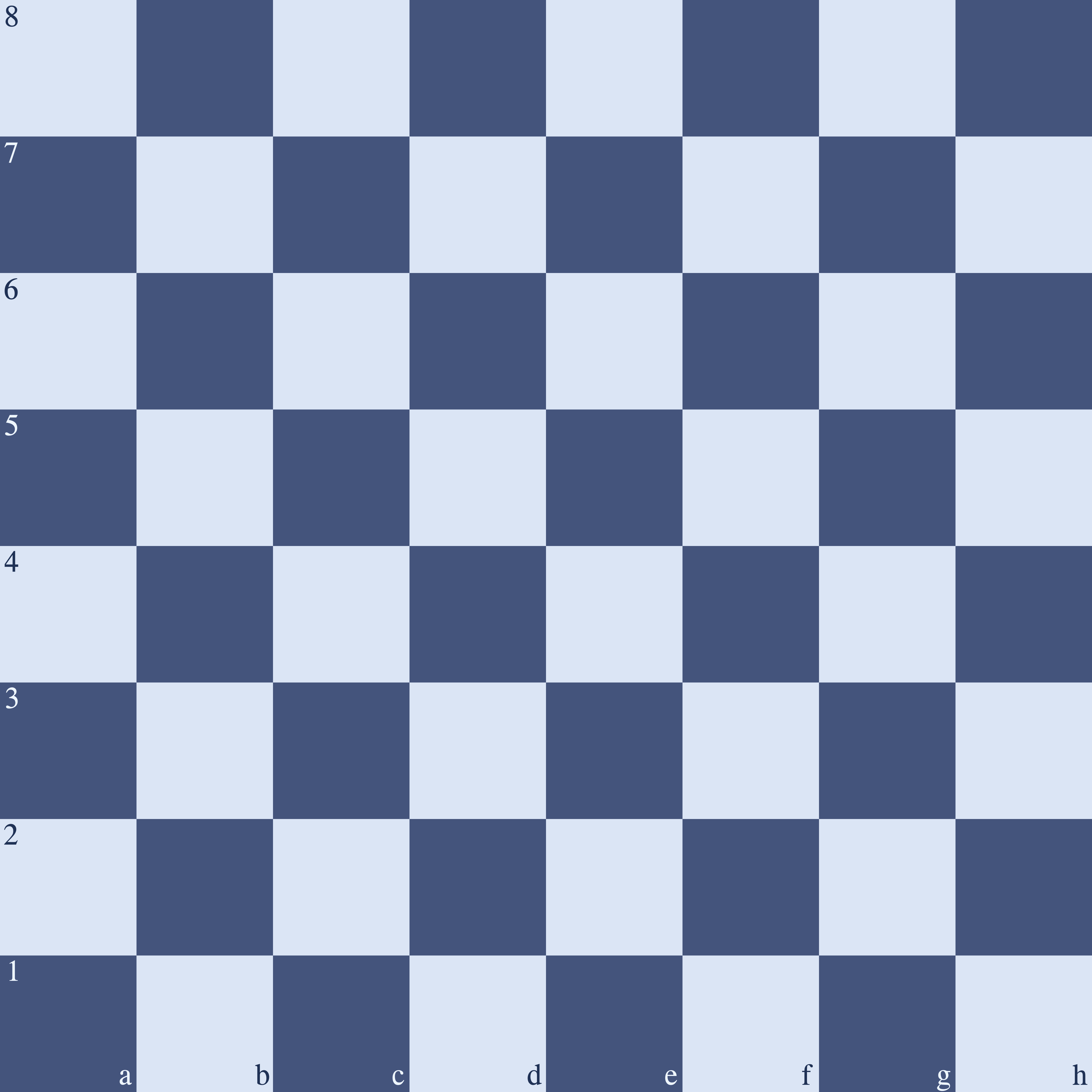
Diagonal with file/rank
A diagonal can cross:
- many files;
- many ranks;
but on each square it occupies, one file and one rank identify the intersection.
Example diagonal:
c1-d2-e3-f4-g5-h6
This diagonal intersects:
- e-file at e3;
- fourth rank at f4;
- h-file at h6.
Diagonal-diagonal intersections
Two diagonals of opposite direction can:
- cross on one square;
- or fail to cross on a board square.
Example:
Diagonal:
- a1-b2-c3-d4-e5-f6-g7-h8.
Opposite-direction diagonal:
- a7-b6-c5-d4-e3-f2-g1.
They intersect on:
- d4.
Same-color condition for diagonal intersection
Because a diagonal consists entirely of one square color:
- a light-square diagonal cannot intersect a dark-square diagonal on a chessboard square.
For two diagonals to share a square:
- they must be on the same color complex;
- and their coordinate paths must actually cross within the board.
Intersections are target squares where independent lines meet.
This becomes important later because one square can be:
- attacked along one line;
- defended along another;
- entered by a knight;
- controlled by a pawn.
A square-centric scan develops this relationship further.
Intersections and piece relationships
Suppose:
- White rook on e1;
- White bishop on b5.
The rook's e-file and bishop's diagonal may cross on a specific square depending on the bishop's line.
That crossing square can become:
- a shared controlled square;
- a possible destination;
- a support point.
At geometry level, we simply identify the crossing.
We do not yet conclude:
- tactic;
- plan;
- strategic importance.
Intersection exercises
Find the intersection
- e-file and fourth rank → e4.
- c-file and seventh rank → c7.
- diagonal a1-h8 and fourth rank → d4.
- diagonal h1-a8 and e-file → e4.
- diagonal c1-h6 and f-file → f4.
Do these diagonals intersect?
Provide pairs of diagonal sequences.
Ask:
- yes/no;
- if yes, name the square.
Purpose: Build cross-line scanning.
Line of sight
For a rook, bishop, or queen, line of sight means there is an unobstructed line from the origin toward the target along a movement-compatible rank/file/diagonal.
The phrase is descriptive chess geometry.
It is not a separate FIDE legal category.
Clear line
Example:
- rook a1;
- target a8;
- squares a2-a7 empty.
The rook has a clear direct line toward a8.
Blocked line
Now add:
- White pawn a4.
The geometric a-file still connects:
- a1 to a8.
But direct rook line of sight beyond a4 is blocked.
Alignment says the squares share a line. Line of sight asks whether that line is unobstructed.
This distinction is essential.
Nearest blocker
For direct sliding reach, the nearest blocker along a chosen ray is decisive.
Suppose:
- rook a1;
- White pawn a4;
- Black queen a7.
The Black queen is aligned with the rook.
But:
- White pawn a4 is the nearest blocker.
Therefore:
- rook does not have direct line of sight to a7.
Removing the nearest blocker
If the pawn on a4 moves away:
- rook line of sight extends farther;
- a7 can become directly visible/reachable depending on remaining occupancy.
This is a geometric transformation.
The tactical term:
- discovered attack;
or other motif
becomes a tactical motif when the alignment is deliberately created or exploited.
Line exists beyond blocker
This safeguard should remain explicit.
If:
- rook a1;
- blocker a4;
- target a7;
then:
- rook and target are still aligned;
- same file still exists;
- direct line of sight is blocked.
Do not write:
"The rook is no longer on the same line as the queen."
It is.
The blocker changes access, not alignment.
| Relationship | Blocker present? | Still true? |
|---|---|---|
| Same file/rank/diagonal | Yes | Yes |
| Geometric alignment | Yes | Yes |
| Direct sliding line of sight | Yes | No beyond blocker |
| Board line beyond blocker | Yes | Yes |
Alignment
Two or more chessmen are aligned when they occupy squares on the same:
- file;
- rank;
- diagonal.
Alignment is a geometric fact.
It does not by itself imply:
- attack;
- pin;
- skewer;
- x-ray;
- tactical opportunity.
Those require additional conditions.
Alignment is geometry, not automatically tactics.
Two-piece alignment
Examples:
- rook a1 / bishop a7 → same file;
- queen d4 / knight h4 → same rank;
- bishop c2 / rook f5 → same diagonal.
Three-piece alignment
Three or more chessmen can occupy the same line.
Example:
- White rook a1;
- White bishop a4;
- Black queen a7.
Order from a1 upward:
- White rook;
- White bishop;
- Black queen.
The order matters.
The rook does not directly reach the queen because:
- bishop is first blocker.
Order along a line
When several objects are aligned, describe their order relative to an origin.
Example from rook a1:
- nearest blocker = a4 bishop;
- farther aligned target = a7 queen.
From queen a7 looking downward:
- nearest blocker = a4 bishop;
- farther aligned piece = a1 rook.
The line is the same.
The direction and nearest object depend on the chosen origin.
Alignment is symmetric. Direct access is origin- and blocker-dependent.
Alignment without attack
Example:
- White rook a1;
- White bishop a4.
They are aligned on the a-file.
The rook does not attack its own bishop.
So:
- aligned: yes;
- direct friendly contact/blocker relationship: yes;
- enemy attack: no.
This reinforces the distinction between:
- geometry;
- attack;
- legality.
Alignment with a knight
A knight can be aligned with another chessman on:
- same file;
- rank;
- diagonal
as a board fact.
But that alignment has no special relation to the knight's movement pattern.
Example:
- knight d4;
- rook d8.
Same file: yes.
Knight attacks rook: not because of file alignment.
"If two pieces are aligned, one attacks the other."
Wrong.
Attack depends on the attacking chessman's movement/capture geometry and blockers.
Alignment exercises
For each group:
- identify shared line;
- list order along line;
- identify nearest blocker from specified origin.
A
Rook a1, bishop a4, queen a7.
B
Bishop c1, pawn e3, rook g5.
C
Queen a4, knight d4, rook h4.
D
Knight d4, king d7.
Question: Aligned? Yes.
Does knight attack because of alignment? No.
Open and occupied lines
At geometry level, a line can be described by its occupancy.
Empty line
No chessmen occupy the relevant segment.
Occupied line
One or more chessmen occupy squares along it.
Clear segment
Between two selected endpoints:
- no blocker lies in between.
Blocked segment
At least one blocker lies between endpoints.
These terms describe board state.
They do not automatically describe strategic value.
Open line after a chessman leaves
Suppose:
Before:
- rook a1;
- bishop a4;
- target a7.
The bishop blocks direct sight.
Then:
- bishop moves away.
After:
- a-file segment between rook and target becomes clear.
Closed line after a chessman enters
Reverse case:
Before:
- rook and target aligned with no intervening blocker.
Then:
- a chessman moves onto a4.
After:
- direct line closes.
A line can open without the slider moving
This is an important board-vision principle.
The rook/bishop/queen may stay on the same square.
A different chessman moves.
Yet:
- its direct reach changes.
Piece geometry is static; occupancy makes access dynamic.
This idea prepares:
- discovered line relationships;
- mobility changes;
- attack-map updates.
Dynamic future calculation is a separate step beyond static geometry.
Geometric "open file" vs strategic open file
At geometry level:
an open line/segment simply means unobstructed for the relationship being discussed.
Strategic chess uses terms such as:
- open file;
- semi-open file;
- open diagonal
with more specific positional meaning.
Do not import all strategic conclusions here.
Board symmetries
The chessboard has several useful geometric symmetries.
These transformations can help:
- verify diagrams;
- recognize equivalent shapes;
- understand mirrored patterns;
- practice coordinates from different orientations.
The important warning is:
geometric symmetry does not always preserve full chess equivalence.
Pawn direction, side to move, castling rights, and history can break the equivalence.
180° rotation
Rotate the board halfway around.
Coordinate mapping examples:
- a1 ↔ h8;
- b2 ↔ g7;
- e4 ↔ d5;
- h1 ↔ a8.
A straight-line shape remains a straight-line shape.
Files/ranks exchange positions visually through rotation, but:
- line lengths;
- adjacency;
- alignment
are preserved geometrically.
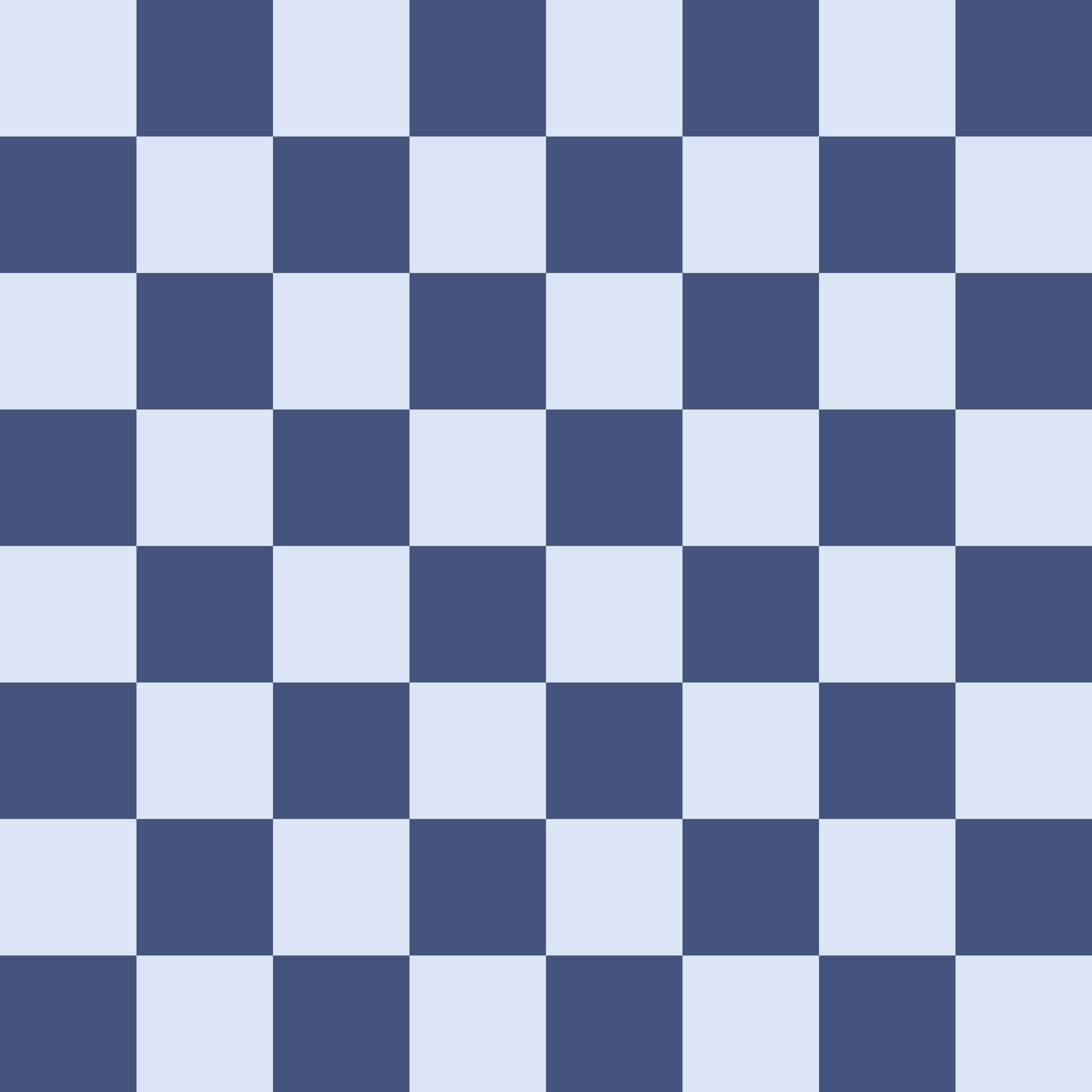
Square colors under 180° rotation
On an 8×8 board, 180° rotation preserves square color.
Example:
- a1 dark;
- h8 dark.
- h1 light;
- a8 light.
This can help sanity-check transformed diagrams.
Vertical reflection
Reflect across the vertical center axis.
File mapping:
- a ↔ h;
- b ↔ g;
- c ↔ f;
- d ↔ e.
Rank numbers remain the same.
Examples:
- a1 ↔ h1;
- c4 ↔ f4;
- d7 ↔ e7.
Square color
On an even-width 8×8 board, this reflection changes square color.
Example:
- a1 dark;
- h1 light.
The color-preservation behavior of transformations is useful for:
- diagram generation QA;
- bishop-color sanity checks.
Do not require beginners to memorize every transformation-color rule.
Horizontal reflection
Reflect across the horizontal center axis.
Rank mapping:
- 1 ↔ 8;
- 2 ↔ 7;
- 3 ↔ 6;
- 4 ↔ 5.
Files remain the same.
Examples:
- a1 ↔ a8;
- e2 ↔ e7;
- h4 ↔ h5.
On the 8×8 board, horizontal reflection also changes square color.
Diagonal reflection
Reflect across a long diagonal.
Example across a1-h8:
- a1 stays a1;
- b1 ↔ a2;
- c1 ↔ a3;
- e4 ↔ d5? No: verify transformation from coordinates rather than intuition.
File/rank exchange under diagonal reflection
Reflection across a1-h8 maps:
- file displacement into rank displacement;
- rank displacement into file displacement.
So:
- a horizontal pattern can become vertical;
- rook geometry remains rook-compatible because rook uses both ranks and files.
Bishop diagonals also transform into diagonals.
Equivalent-looking geometry
Suppose a simple pattern contains:
- rook;
- blocker;
- target
on one file.
Rotate the board 180°.
The relationship:
- aligned;
- nearest blocker;
- target beyond blocker
is preserved.
This makes symmetry useful for:
- creating exercise variants;
- checking conceptual equivalence;
- avoiding overfitting to one board corner.
Limits of symmetry in real chess
A board transformation may preserve pure geometry but change legal/game meaning.
Pawn direction
White pawns move toward increasing ranks.
Black pawns move toward decreasing ranks.
A geometric reflection that leaves colors unchanged can turn:
- legal pawn direction
into
- illegal pawn direction
unless colors/directions are transformed appropriately.
Side to move
Same transformed board geometry with:
- different side to move
can produce a different legal position.
Castling rights
A transformed board picture does not automatically carry valid castling history.
En-passant state
Immediate previous-move history can differ even under identical geometry.
Initial-position asymmetry
Queen/king placement and White-to-move mean the chess game is not simply:
- any geometric symmetry = same legal game.
Geometry can be symmetric while chess state is not.
Symmetry exercises
1. 180° rotation
Map:
- a1;
- c3;
- e4;
- h8.
2. Vertical reflection
Map:
- a4;
- b7;
- d2.
3. Horizontal reflection
Map:
- c1;
- e3;
- h6.
4. Geometry preservation
Show:
- rook-blocker-target alignment.
Ask: After 180° rotation, are they still aligned?
Answer: Yes.
5. Legal-equivalence warning
Show a pawn structure and its naive reflection.
Ask: Is the reflected diagram automatically an equivalent legal chess position?
Answer: No.
Reason: pawn direction, side to move, and history-dependent rights may differ.
Line-structure synthesis
A strong static board scan can now distinguish several layers.
Layer 1 — coordinates
Where are the squares?
Layer 2 — line family
Do two squares share:
- rank;
- file;
- diagonal?
Layer 3 — alignment
Which chessmen occupy that same line?
Layer 4 — order
Which chessman is:
- nearest;
- farther;
- between?
Layer 5 — line of sight
Is the segment unobstructed?
Layer 6 — occupancy change
What opens/closes if a chessman leaves or enters?
Layer 7 — transformation
Does the same geometry appear elsewhere under:
- rotation;
- reflection?
Line-of-sight mastery check
- [ ] I can find file/rank intersections instantly.
- [ ] I can identify diagonal intersections.
- [ ] I distinguish alignment from direct line of sight.
- [ ] I identify the nearest blocker along a ray.
- [ ] I can order three aligned chessmen.
- [ ] I understand a blocker changes access, not the existence of the line.
- [ ] I recognize when a line opens/closes.
- [ ] I can interpret basic board rotations/reflections.
- [ ] I understand geometric symmetry does not guarantee legal-state equivalence.
Putting line geometry together
The chessboard is now a network of:
- files;
- ranks;
- diagonals;
- directional rays;
- intersections;
- alignments;
- occupied/clear segments.
The next area asks:
How does each chessman experience this network differently?
A rook sees:
- file/rank rays.
A bishop sees:
- diagonal color-bound rays.
A queen sees:
- both.
A knight sees:
- a non-linear destination graph.
A king sees:
- adjacency.
A pawn sees:
- directional movement and directional attack.