












Every chessman occupies the same board.
But every chessman experiences that board through a different movement geometry.
A rook reads:
- ranks;
- files.
A bishop reads:
- diagonals;
- one permanent square-color complex.
A queen combines:
- rank/file geometry;
- diagonal geometry.
A knight does not use straight lines at all.
A king sees immediate adjacency.
A pawn has directional movement and a different directional attack map.
This section begins with the three sliding chessmen.
A spatial model for every chessman
For board-vision purposes, a chessman can be described through several geometric questions.
1. What movement family does it belong to?
Useful explanatory families:
- slider;
- leaper;
- short-range adjacency piece;
- directional pawn.
These are explanatory categories, not FIDE piece classes.
2. What is its raw board pattern?
Ignore:
- blockers;
- king safety;
- tactical consequences.
Ask:
Which destination relationships are built into this chessman's movement geometry?
3. How does the board boundary change the pattern?
The same movement rule can produce different footprints from:
- center;
- edge;
- corner.
4. How does occupancy change direct access?
For sliders:
- first blocker ends direct reach on that ray.
For a knight:
- intermediate occupancy is irrelevant;
- destination occupancy still matters.
5. How does legal chess further constrain the geometry?
The rules of chess establish:
- geometrically reachable does not always mean legally playable;
- own-king safety can prohibit a move;
- attack and legal move are not identical concepts.
The goal here is to map that geometry reliably.
| Chessman | Core spatial model | Straight-line rays? | Jumps intervening pieces? | Direction-dependent? |
|---|---|---|---|---|
| Rook | Rank + file slider | Yes | No | No |
| Bishop | Diagonal slider | Yes | No | No |
| Queen | Rank + file + diagonal slider | Yes | No | No |
| Knight | 2+1 destination graph | No | Yes | No |
| King | Adjacent-square neighbourhood | No long rays | No | No |
| Pawn | Forward move map + diagonal attack map | Limited directional structure | No | Yes |
The board is constant. The piece-specific spatial model changes.
Raw reach, direct reach, and move availability
Before studying individual pieces, separate three ideas.
Raw empty-board reach
Squares the piece's ordinary movement geometry could connect to on an otherwise empty board.
This answers:
What footprint does this piece have before occupancy and king-safety constraints?
Occupancy-conditioned direct reach
Take the real occupied board into account.
For sliders:
- friendly blocker stops before its square;
- enemy blocker can be a capture/contact square;
- squares beyond the first blocker are inaccessible directly.
Legal move availability
Apply all legal rules:
- own-king safety;
- check;
- special conditions.
A square can belong to:
- raw geometry;
but not
- current legal moves.
Rook geometry
The rook is the cleanest expression of rectangular board geometry.
It moves along:
- the rank on which it stands;
- the file on which it stands.
That creates four directional rays from an interior square:
- file upward;
- file downward;
- rank one way;
- rank the other way.
Rook ray map
Example:
Rook on d4.
Same file
- d1;
- d2;
- d3;
- d5;
- d6;
- d7;
- d8.
Same rank
- a4;
- b4;
- c4;
- e4;
- f4;
- g4;
- h4.
Raw empty-board reach:
14 squares.
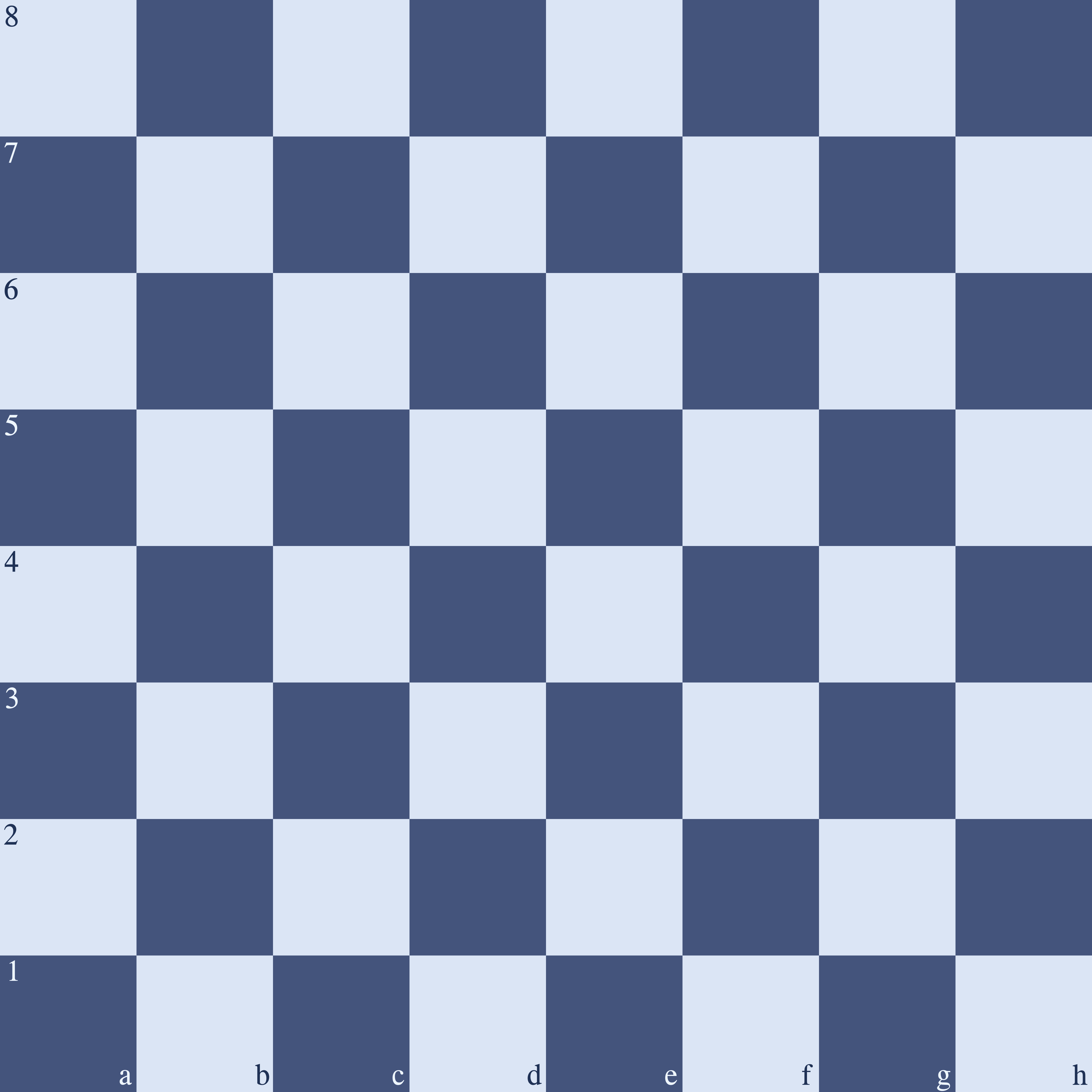
The surprising invariant: rook raw reach is always 14
Move an empty-board rook to:
- a1;
- a4;
- d4;
- h8.
Its ray lengths redistribute.
But the total raw destination count stays:
14.
Why?
From any square:
- seven other squares share its rank;
- seven other squares share its file.
Those sets overlap only on the rook's own square, which is excluded.
Therefore:
7 + 7 = 14 raw reachable squares.
Rook location changes ray lengths, but not total empty-board raw reach.
Corner rook
Rook a1:
- 7 squares on a-file;
- 7 squares on first rank.
Total: 14.
The geometry looks less "central," but the raw empty-board count is unchanged.
Rook geometry and board boundaries
From d4:
rays are split relatively evenly.
From a1:
only two of the four directional orientations contain board squares:
- toward h1;
- toward a8.
So the board boundary changes:
- directional distribution;
not
- total raw rook footprint.
This makes the rook different from:
- bishop;
- queen;
- knight;
- king.
Rook line of sight
With occupancy:
Rook d4.
Suppose:
- White pawn d6;
- Black bishop b4;
- Black queen h4.
Direct reach:
Up file
- d5 reachable;
- d6 friendly blocker;
- d7/d8 inaccessible directly.
Left rank
- c4 reachable;
- b4 enemy first blocker/capture square;
- a4 inaccessible directly beyond b4.
Right rank
- e4;
- f4;
- g4;
- h4 enemy first blocker/capture square.
Rook geometry is global; direct rook access is blocker-limited ray by ray.
Rook routes between squares
On an empty board:
Same rank/file
A rook can connect the squares in one move.
Examples:
- a1 → a8;
- c4 → h4.
Different rank and file
A rook cannot connect them in one move.
But on an empty board, it can usually connect them in two rook moves through an intersection square.
Example:
- a1 → h8.
Possible route:
- a1 → a8 → h8.
Or:
- a1 → h1 → h8.
On an empty board, find one shortest rook route:
- a1 → h8
- c3 → f7
- e4 → e8
- b6 → g6
Answers:
- 2 moves;
- 2 moves;
- 1 move;
- 1 move.
Bishop geometry
The bishop moves along diagonals.
Its geometry has one property no rook or queen shares in the same permanent way:
a bishop never changes square color through ordinary bishop movement.
Permanent color binding
A bishop on a light square can reach only:
- light squares.
A bishop on a dark square can reach only:
- dark squares.
Example:
Bishop c1 begins on a dark square.
Its entire movement graph is confined to dark squares.
One bishop can never reach the opposite color complex.
This is a geometric impossibility, not merely a difficult route.
Same-color reachability
On an empty board:
any two squares of the same color can be connected by a bishop in at most two moves.
Why?
- if they share a diagonal → one move;
- if they do not → a suitable same-color diagonal intersection can connect the route in two moves.
Squares of opposite colors:
- unreachable by that bishop under any number of bishop moves.
Can one bishop travel between:
- c1 → h6
- c1 → a3
- c1 → c3
- d4 → f6
- d4 → e4
Classify:
- one move;
- two moves;
- impossible by one bishop forever because square color differs.
Bishop raw footprint changes by square
Unlike the rook, bishop raw reach depends strongly on its location.
Corner
Bishop a1:
- b2;
- c3;
- d4;
- e5;
- f6;
- g7;
- h8.
Raw reach: 7 squares.
Central square
Bishop d4:
- e5-f6-g7-h8;
- c5-b6-a7;
- e3-f2-g1;
- c3-b2-a1.
Raw reach: 13 squares.
The same maximum occurs on the four central squares:
- d4;
- e4;
- d5;
- e5.
Why central bishop reach grows
A bishop needs useful board length in several diagonal directions.
Near a corner:
- most directions terminate immediately at the edge.
Near the center:
- all four diagonal directions have substantial length.
Bishop raw reach is highly location-dependent.
Strategic warning
More raw squares does not automatically mean:
- better bishop;
- stronger position.
A central bishop can be:
- blocked;
- exposed;
- tactically bad.
A corner bishop can have:
- a long useful diagonal.
Strategic piece quality depends on much more than geometric mobility alone.
Bishop blockers
Bishop c1.
Suppose:
- White pawn d2.
The diagonal c1-d2-e3-f4-g5-h6 exists.
But:
- d2 is the first blocker.
Direct bishop access along that ray:
- stops immediately.
If d2 moves:
- the diagonal can open.
Again:
geometric diagonal existence ≠ direct current access.
Bishop route relation
A useful bishop-space question is:
Do origin and target share the bishop's color complex?
If no:
- impossible.
If yes:
- ask whether one diagonal connects directly;
- otherwise search for a same-color intersection route.
This is the beginning of bishop route visualization.
Dynamic tactical calculation remains later.
Queen geometry
The queen combines:
- rook geometry;
- bishop geometry.
It moves along:
- rank;
- file;
- diagonal.
Queen as a union geometry
For raw empty-board footprint:
queen footprint = rook footprint ∪ bishop footprint
The two sets do not overlap except at the queen's origin, which is not counted as a destination.
Example: Queen d4.
- rook-style raw squares = 14;
- bishop-style raw squares = 13.
Total: 27 raw squares.
Queen geometry is the union of rook and bishop line geometry.
Queen minimum and maximum raw footprint
On an empty standard board:
Corner queen
Example a1:
- rook component = 14;
- bishop component = 7;
- total = 21.
Central queen
Example d4:
- rook component = 14;
- bishop component = 13;
- total = 27.
So queen raw reach varies:
21–27 squares
depending on location.
| Queen square example | Rook component | Bishop component | Total raw reach |
|---|---|---|---|
| a1 | 14 | 7 | 21 |
| d4 | 14 | 13 | 27 |
| e5 | 14 | 13 | 27 |
Why the queen changes but rook does not
The queen always keeps:
- rook component = 14.
What changes is:
- bishop component.
So queen location sensitivity comes from its diagonal geometry.
Queen blockers partition rays independently
A blocker on one queen ray does not erase the other rays.
Example: Queen d4.
Friendly pawn:
- d6.
This stops upward file access beyond d6.
But it does not affect:
- horizontal rays;
- other file direction;
- diagonal rays.
Slider blockers are local to the affected ray.
This is useful for board scanning: do not treat one blocker as if it freezes the entire queen.
Queen-square relation test
Given queen origin and target:
Ask:
Same rank?
If yes:
- queen-line relationship exists.
Same file?
If yes:
- queen-line relationship exists.
Same diagonal?
If yes:
- queen-line relationship exists.
None?
Then:
- queen cannot reach target in one ordinary queen move on an empty board.
Queen on d4.
Can it reach in one empty-board move:
- d8 → yes, file;
- h4 → yes, rank;
- h8 → yes, diagonal;
- b2 → yes, diagonal;
- f5 → no;
- c6 → no.
Queen routes on an empty board
Between any two different squares on an empty board, a queen needs:
- 1 move if aligned by rank/file/diagonal;
- otherwise 2 moves.
This follows from the queen's combined line geometry.
Find a two-move queen route from:
- a1 → f7.
Example:
- a1 → a7 → f7.
Other valid routes may exist.
Shortest empty-board route ≠ best chess route.
Slider comparison
| Property | Rook | Bishop | Queen |
|---|---|---|---|
| Rank rays | Yes | No | Yes |
| File rays | Yes | No | Yes |
| Diagonal rays | No | Yes | Yes |
| Jumps blockers | No | No | No |
| Empty-board minimum raw reach | 14 | 7 | 21 |
| Empty-board maximum raw reach | 14 | 13 | 27 |
| Permanently color-bound | No | Yes | No |
Rook reach count is location-invariant on an empty board. Bishop and queen reach are location-sensitive.
Rook, bishop, and queen geometry summary
The three sliders all use straight board structures.
Rook
- rank + file;
- 4 ray directions;
- exactly 14 empty-board raw destinations from every square.
Bishop
- diagonals;
- permanently color-bound;
- raw footprint varies with square;
- 7–13 empty-board destinations.
Queen
- rook + bishop union;
- up to 8 ray directions;
- raw footprint varies 21–27.
For every slider:
- line geometry exists independent of occupancy;
- first blocker controls direct reach on each ray;
- legal move set can be narrower than geometric reach.
The next section covers pieces whose geometry cannot be described simply as long straight rays.