






Rooks, bishops, and queens experience the board through rays.
The knight, king, and pawn do not.
Their geometry is local or directional:
- knight → discrete 2+1 jumps;
- king → immediate adjacency;
- pawn → forward movement map + diagonal attack map.
These pieces make the board's edge effects especially visible.
This section also introduces a general concept:
piece footprint.
Knight geometry
The knight has the most distinctive movement geometry in orthodox chess.
From an origin square, a knight destination changes:
- one coordinate by 2;
- the other coordinate by 1.
Equivalently:
- two squares in one orthogonal direction;
- one square perpendicular to that.
The knight does not travel along a rank, file, or diagonal between origin and destination.
The eight theoretical knight offsets
Using coordinate displacement:
- (+2,+1)
- (+2,-1)
- (-2,+1)
- (-2,-1)
- (+1,+2)
- (+1,-2)
- (-1,+2)
- (-1,-2)
From a sufficiently central square, all eight land on the board.
Example: knight d4.
Destinations:
- b3;
- b5;
- c2;
- c6;
- e2;
- e6;
- f3;
- f5.
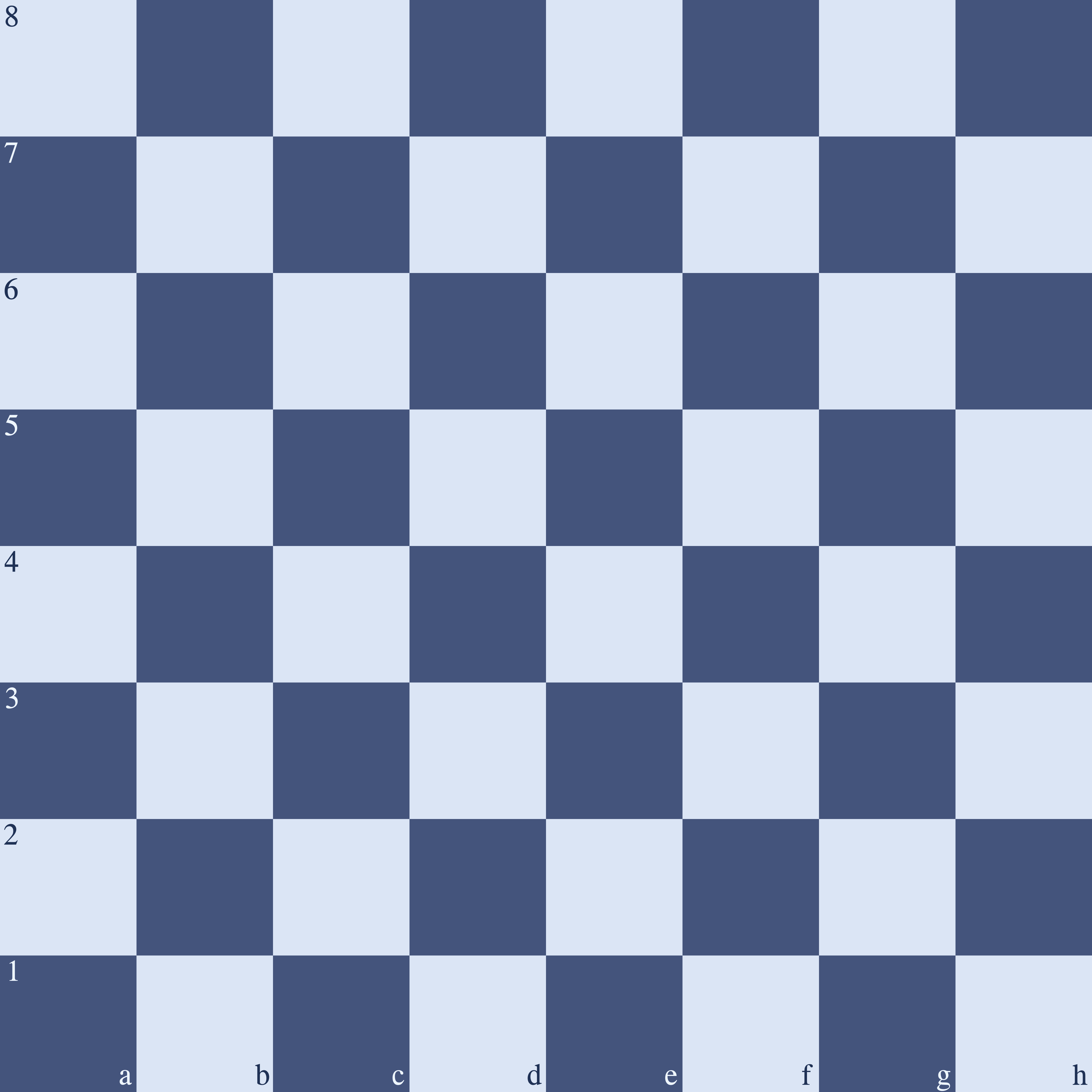
Knight geometry is a destination pattern, not a path of intervening squares.
Knight jumping
Intermediate occupied squares do not block a knight.
Suppose a knight is surrounded by chessmen on all adjacent squares.
It may still jump to a legal knight destination if:
- that destination itself is available under occupancy/legal rules.
The knight does not need:
- an empty corridor;
- a clear diagonal;
- a clear file.
Destination occupancy still matters
Jumping does not mean:
"occupancy never matters."
At the destination:
- friendly chessman → cannot move there;
- enemy chessman → may be captured if move is legal;
- empty → may be reachable.
The knight ignores intervening occupancy, not destination occupancy.
Knight center, edge, and corner effects
The board boundary truncates the eight theoretical offsets.
Central footprint
From several central squares, a knight can have:
8 raw destinations.
Example: d4.
Corner
From a1:
only:
- b3;
- c2.
Raw destinations: 2.
Edge examples
An edge square can have:
- fewer than 8;
- exact count depends on location.
Example: a4.
Destinations:
- b2;
- c3;
- c5;
- b6.
Raw destinations: 4.
Knight raw footprint is strongly compressed by board edges.
Knight square-color alternation
Every knight move changes square color.
Therefore:
- light → dark;
- dark → light.
This gives a route-parity rule.
One move
Target must be opposite color.
Two moves
Target returns to same color.
Three moves
Opposite color.
And so on.
Knight route parity alternates square color every move.
This can reject impossible route-length guesses quickly.
Example:
- origin and target same color;
- one knight move claimed.
Impossible.
Knight routes are non-linear
A knight cannot be guided by:
- drawing one straight segment from origin to target.
Its route belongs to a graph of discrete jumps.
This makes intuitive distance different from:
- rook distance;
- bishop distance;
- king distance;
- visual Euclidean closeness.
A nearby square can take several moves
Squares that are visually adjacent are not knight-adjacent.
Example: a1 → a2.
The target is physically next to the origin.
But a knight cannot move there directly.
A visually farther square can be one move away
Example: d4 → f5.
Euclidean-looking distance is larger than one square.
Yet:
- it is a single knight move.
For knights, visual closeness and move distance are different ideas.
Knight distance
On an empty board, define knight distance between two squares as:
the minimum number of knight moves required to travel from one square to the other.
This is a graph-distance concept.
Examples:
- d4 → f5 = 1;
- a1 → c2 = 1;
- same origin/target = 0.
Some distances require several jumps.
On the standard empty 8×8 board, the maximum knight distance is:
6 moves.
The diameter 6 is attained only by diagonally opposite corner pairs:
- a1 ↔ h8;
- a8 ↔ h1.
This is an advanced spatial fact, not required beginner knowledge.
Knight route exercise
On an empty board:
- d4 → f5
- a1 → c2
- a1 → h8
- a1 → a2
Ask:
- estimate minimum knight moves;
- then verify with an interactive pathfinder.
Learning goal: replace visual-distance intuition with knight-graph intuition.
King geometry
Ignoring attacked-square legality for a moment, the king moves to an adjoining square.
Its geometric footprint is the surrounding neighbourhood.
From an interior square, that can include:
- horizontal neighbours;
- vertical neighbours;
- diagonal neighbours.
King neighbourhood size
Interior square
Example: king d4.
Adjacent squares:
- c3;
- d3;
- e3;
- c4;
- e4;
- c5;
- d5;
- e5.
Raw neighbourhood: 8 squares.
Non-corner edge square
Example: king a4.
Neighbours:
- a3;
- a5;
- b3;
- b4;
- b5.
Raw neighbourhood: 5 squares.
Corner
King a1.
Neighbours:
- a2;
- b1;
- b2.
Raw neighbourhood: 3 squares.
| King location | Raw adjacent squares |
|---|---|
| Interior | 8 |
| Non-corner edge | 5 |
| Corner | 3 |
King movement rule is constant; boundary changes neighbourhood size.
King distance on an empty board
Ignore:
- attacked squares;
- blockers;
- checks.
Suppose the king must travel from one square to another.
Because the king can change:
- file;
- rank;
or both in one move, the shortest empty-board geometric distance is:
max(file difference, rank difference).
This is known mathematically as Chebyshev distance.
The name is optional.
The practical rule is:
close file and rank differences simultaneously whenever possible.
Example: d4 → f7
Differences:
- file: 2;
- rank: 3.
Minimum empty-board king moves: 3.
Possible route:
- d4-e5-f6-f7.
Example: a1 → h8
Differences:
- 7 files;
- 7 ranks.
Minimum: 7 king moves.
Diagonal progress closes both differences at once.
Find minimum empty-board king distance:
- a1 → h8 = 7
- d4 → f7 = 3
- c3 → c8 = 5
- b2 → g2 = 5
Legal king route differs from geometric king route
In actual chess:
- attacked squares may be forbidden;
- occupied squares may obstruct;
- kings may not become adjacent illegally.
Therefore:
empty-board king distance ≠ legal route length in every position.
Pawn geometry
The pawn is unique because its:
- movement map;
- attack map
are different.
It is also directional.
White and Black see mirrored forward directions.
White pawn directional model
White pawns move toward increasing rank numbers.
Example: White pawn e4.
Forward-move direction
- e5.
Attack directions
- d5;
- f5.
Movement and attacks are not the same footprint.
Black pawn directional model
Black pawns move toward decreasing rank numbers.
Example: Black pawn e5.
Forward-move direction
- e4.
Attack directions
- d4;
- f4.
A pawn does not attack the square directly in front of it.
Initial double-step geometry
From its original rank:
White pawn:
- rank 2.
Black pawn:
- rank 7.
A pawn may have a two-square forward move only if:
- first square is clear;
- second square is clear;
- full legal conditions hold.
Geometrically, the pawn does not jump over the first square.
Example: White e2 → e4.
Path relation:
- e3 must be empty;
- e4 must be empty.
Why this differs from the knight
Knight:
- ignores intervening squares.
Pawn double-step:
- requires the intermediate square to be clear.
Two-square pawn move is a two-square destination with a clear-path requirement, not a jump.
Pawn edge-file effect
A pawn attacks diagonally forward on adjacent files.
From an interior file:
- usually two geometric attack directions.
From an edge file:
- only one exists on the board.
Example:
White pawn a5 attacks only:
- b6.
There is no file to the left of a-file.
White pawn h5 attacks only:
- g6.
Pawn movement footprint vs attack footprint
For a pawn, one single footprint label can be misleading.
Keep two maps:
Movement footprint
Potential forward destinations subject to occupancy and first-move conditions.
Attack footprint
Diagonal-forward squares the pawn attacks.
Pawn geometry must be represented with at least two maps: move map and attack map.
This prepares 03.4, where attacked squares are mapped systematically.
Promotion direction as geometry
White pawns move toward:
- rank 8.
Black pawns move toward:
- rank 1.
The furthest rank is therefore built into pawn directional geometry.
Promotion is governed by the rules of chess; here the focus is the pawn’s geometry before it promotes.
Piece footprints
A piece footprint is the spatial set associated with a chessman's current geometry from a chosen square.
Because several layers exist, always specify which kind of footprint you mean.
Raw footprint
Empty-board geometric destinations or effects.
Examples:
- rook d4 raw footprint = 14;
- knight d4 raw footprint = 8;
- king d4 raw neighbourhood = 8.
Occupancy-aware footprint
Adjust for:
- board occupancy;
- slider blockers;
- friendly destination occupancy;
- enemy contact/capture squares.
Attack footprint
Squares the piece attacks under the chess attack definition.
This is not always the same as:
- legal move set.
The next layer is to translate these footprints into attacked and defended squares.
Legal-move footprint
Squares available as legal moves after:
- king safety;
- check constraints;
- special rules.
Legality can further restrict which geometrically available moves may actually be played.
When possible, qualify footprint:
raw footprint;occupancy-aware footprint;attack footprint;legal-move footprint.
Do not let one visual overlay silently stand for all four.
Comparing raw footprints
On an empty board, useful representative counts are:
| Chessman | Corner example | Edge example | Central/interior example | Key behavior |
|---|---|---|---|---|
| Rook | 14 | 14 | 14 | Count invariant; ray distribution changes |
| Bishop | 7 at corner | Varies | 13 max at d4/e4/d5/e5 | Color-bound; diagonal lengths matter |
| Queen | 21 at corner | Varies | 27 max at d4/e4/d5/e5 | Rook 14 + bishop component |
| Knight | 2 at corner | Often 3–4 depending edge square | Up to 8 | Strong edge compression |
| King | 3 at corner | 5 at non-corner edge | 8 | Immediate neighbourhood |
| Pawn attacks | 1 on edge file | 1 on edge file | Usually 2 away from edge | Direction/color dependent |
This table is geometric.
It is not a piece-value table.
It does not say:
- queen is worth 27;
- rook is "equally good everywhere";
- central knight is automatically strong.
Strategic interpretation belongs later.
Edge effects across pieces
Board edges affect pieces differently.
Rook
Raw empty-board count:
- unchanged at 14.
But:
- directions/ray lengths redistribute.
Bishop
Edges and corners can sharply shorten:
- several diagonal rays.
Raw reach may fall to:
- 7 at a corner.
Queen
Rook component stays 14.
Bishop component shrinks near edges/corners.
Total raw footprint therefore shrinks.
Knight
Most dramatic local compression.
- center → up to 8;
- corner → 2.
King
Neighbourhood:
- interior 8;
- edge 5;
- corner 3.
Pawn
Edge file removes one diagonal attack direction.
"Edge effect" is piece-specific.
Do not use one generic rule such as:
"Every piece loses mobility near the edge in the same way."
That is false.
Footprint changes caused by blockers
For sliders:
- blockers can shrink direct occupancy-aware footprint dramatically.
For knight:
- intervening blockers do not shrink the jump pattern;
- occupied destination squares still affect availability.
For king:
- nearby occupancy can shrink current destinations.
For pawn:
- forward occupancy affects move map;
- diagonal occupancy affects capture availability;
- attack map remains a separate spatial concept.
Geometric reach vs blocked reach vs attack vs legal reach
This is the central hierarchy of 03.3.
These concepts must not be collapsed.
1. Raw geometric reach
Where movement geometry points on an empty/boundary-limited board.
2. Occupancy-conditioned direct reach
What remains accessible after:
- blockers;
- destination occupancy.
3. Attack/control relationship
Which squares count as attacked under chess rules.
Important FIDE safeguard:
a chessman can attack a square even when moving there would be illegal because that move would expose its own king.
4. Legal movement
Moves permitted after applying:
- own-king safety;
- check;
- special legal conditions.
5. Safe/practical movement
A legal move can still:
- hang a queen;
- lose material;
- be strategically bad.
Safety/value belongs to later evaluation and decision domains.
Geometrically reachable, attacked, legal, safe, and good are different claims.
Pinned-piece example
Suppose:
- White king e1;
- White rook e2;
- Black rook e8.
White rook e2 has horizontal rook geometry.
It attacks horizontal squares under the FIDE attack definition.
But moving away from the e-file can expose White king.
Therefore:
- geometric/attack footprint can contain a square;
- corresponding legal move may be forbidden.
This is why an attack footprint should not be defined simply as:
"all legal destinations."
Safe movement is yet another layer
Suppose a knight has:
- a legal destination on f5.
But an enemy pawn attacks f5.
The move may be:
- geometrically valid;
- legally allowed;
- strategically/materially bad.
So do not color every legal destination as "safe."
Likewise:
- a legal queen move can lose the queen;
- a legal pawn move can create checkmate against yourself? No, that would be illegal if own king is left in check; but it can permit opponent mate next move.
Calculation and strategy evaluate what those geometric facts mean in a concrete position.
Piece-footprint exercises
1. Raw rook footprint
Place rook on:
- a1;
- d4;
- h6.
Ask: How many raw empty-board destinations?
Answer: 14 each.
2. Bishop footprint
Compare:
- a1;
- d4.
Ask: Which has larger raw footprint?
Answer: d4.
3. Queen footprint
Compare:
- a1 = 21;
- d4 = 27.
Explain: difference comes from bishop component.
4. Knight footprint
Compare:
- a1;
- a4;
- d4.
Count:
- 2;
- 4;
- 8.
5. King neighbourhood
Count from:
- a1;
- a4;
- d4.
Answer:
- 3;
- 5;
- 8.
6. Pawn map split
White pawn e4.
Mark:
- movement square;
- attack squares.
Then repeat: Black pawn e5.
7. Blocker effect
Rook d4 with:
- friendly pawn d6;
- enemy bishop b4.
Mark:
- raw geometry;
- direct reach;
- first blockers.
8. Pinned footprint
Use the e-file pinned-rook example.
Ask separately:
- Does the rook geometrically reach h2?
- Does it attack h2?
- Is
Rh2legal?
Expected:
- geometry: yes;
- attack under FIDE definition: yes;
- legal move: no if king would be exposed.
9. Knight distance
Use an interactive shortest-path tool for:
- a1 → h8.
Answer: 6.
10. King distance
Empty board:
- d4 → f7.
Answer: 3.
Piece-geometry mastery check
- [ ] I classify sliders, knight, king, and pawn spatial models.
- [ ] I know rook raw reach is 14 from every empty-board square.
- [ ] I understand bishop color binding.
- [ ] I can compare bishop corner/center footprints.
- [ ] I understand queen geometry as rook + bishop union.
- [ ] I can map all eight knight offsets.
- [ ] I know knight moves change square color.
- [ ] I understand knight distance as a shortest-jump problem.
- [ ] I can count king neighbourhoods at center/edge/corner.
- [ ] I understand empty-board king distance.
- [ ] I separate pawn movement and attack maps.
- [ ] I understand edge effects differ by piece.
- [ ] I distinguish raw, occupancy-aware, attack, and legal footprints.
Putting piece footprints together
Every chessman now has a distinct spatial model.
Rook
- rank/file rays;
- raw count = 14 everywhere.
Bishop
- diagonal rays;
- color-bound;
- 7–13 raw empty-board destinations.
Queen
- rook+bishop union;
- 21–27 raw destinations.
Knight
- discrete 2+1 graph;
- jump;
- 2–8 raw destinations;
- color alternation;
- route distance is non-linear.
King
- adjacency;
- 3 / 5 / 8 neighbourhood structure;
- shortest empty-board distance closes file/rank differences together.
Pawn
- directional;
- move map ≠ attack map;
- edge files reduce attack directions.
The next area shifts focus from:
"Where can this piece geometrically reach?"
to:
"Which squares are attacked, controlled, defended, contested, or influenced in the current position?"